


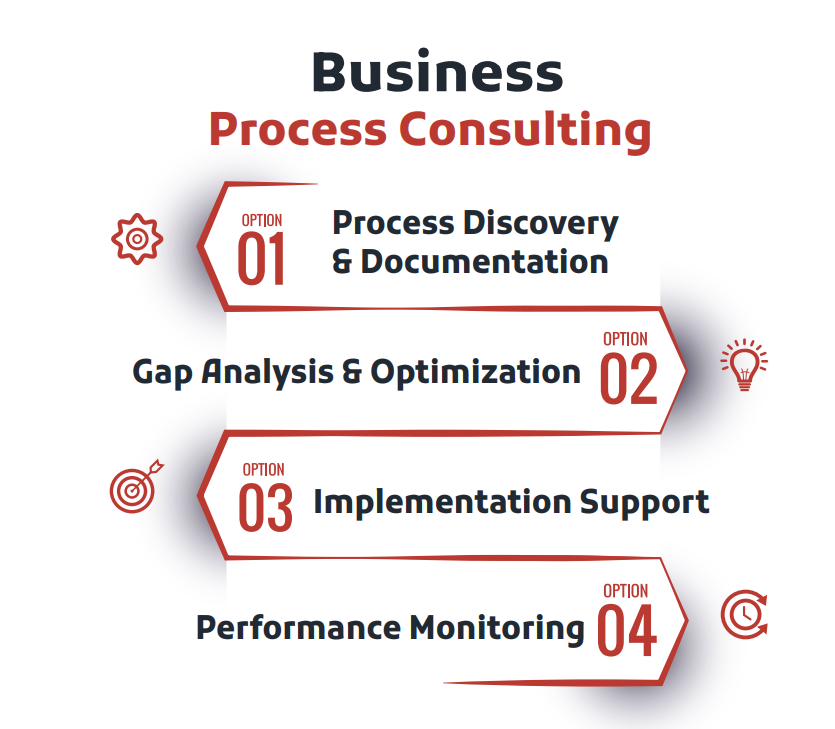
Process Discovery & Documentation
Goal: Understand how work actually gets done.
- Methods:
- Interviews and workshops with staff.
- Shadowing employees during tasks.
- Reviewing SOPs, system logs, and reports.
Outcome: A visual map (e.g., flowcharts or BPMN diagrams) of current workflows, revealing informal practices and undocumented steps.
Gap Analysis & Optimization
Goal: Identify inefficiencies and areas for improvement.
- Focus Areas:
- Bottlenecks and delays.
- Redundant approvals or manual tasks.
- Compliance risks or audit findings.
- Tools Used:
- Lean Six Sigma, root cause analysis.
- ERP systems (e.g., SAP, Oracle, Odoo).
- Automation platforms (e.g., RPA tools like UiPath).
Outcome: A set of actionable recommendations, often including process redesign, automation, or policy changes.
Implementation Support
Goal: Ensure smooth transition to improved processes.
- Activities:
- Change management planning.
- Staff training and onboarding.
- Pilot testing and phased rollouts.
Outcome: New processes are adopted with minimal disruption, and employees are equipped to work effectively.
Performance Monitoring
Goal: Track success and drive continuous improvement.
- Tools:
- Dashboards (e.g., Power BI, Tableau).
- KPIs like cycle time, error rate, throughput.
- Feedback loops and regular reviews.
- Outcome: Data-driven insights to refine processes over time.
Get a personal consultation.
Contact
Phone
Saudi Arabia: +966-567720769
Egypt: +20-1115215479
Bahrain: +973-34568544
Egypt: +20-1115215479
Bahrain: +973-34568544